
Five Questions That Reveal Your Agency’s Planning Gap
A planning gap is the space between the decisions an agency must make and what its current systems can actually show. Most agencies have one.
A planning gap is the space between the decisions an agency must make and what its current systems can actually show. Most agencies have one.

This article is for agency leaders who want accurate time data without turning timesheets into a weekly fight. It lays out a simple Friday and Monday rhythm, clear ownership, and language that makes time tracking feel like protection, not policing.

This article is for agency leaders, resource managers, and ops teams who are tired of weekly resourcing meetings that feel long on discussion and short on decisions. It breaks down a simple agenda, prep questions, and decision rules so teams can spot conflicts early, make tradeoffs faster, and leave with a plan people can actually follow.

The metrics most agency owners track tell a clean story about revenue and utilization and miss almost everything that determines whether the business is still standing in two years.
A planning gap is the space between the decisions an agency must make and what its current systems can actually show. Most agencies have one.

Join us for a candid conversation on how one agency’s $100K mistake reveals what most leaders are missing.
This article is for agency leaders, resource managers, and ops teams who are tired of weekly resourcing meetings that feel long on discussion and short on decisions. It breaks down a simple agenda, prep questions, and decision rules so teams can spot conflicts early, make tradeoffs faster, and leave with a plan people can actually follow.
This article is for agency leaders who want accurate time data without turning timesheets into a weekly fight. It lays out a simple Friday and Monday rhythm, clear ownership, and language that makes time tracking feel like protection, not policing.
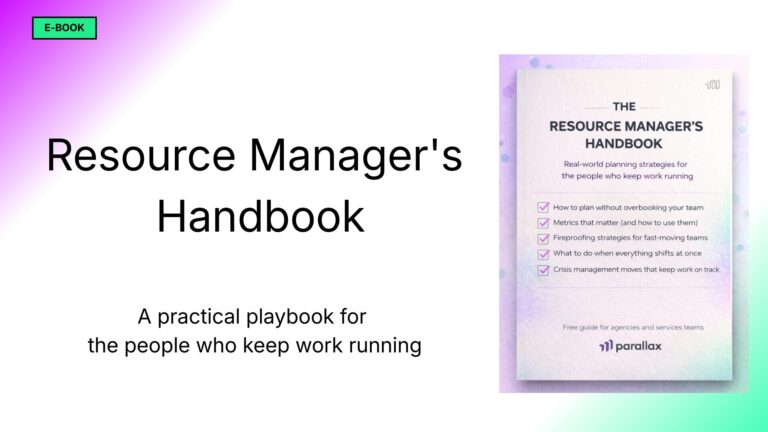
The Resource Manager’s Handbook is a practical guide to planning, forecasting, and managing workloads without stretching your tools past their limits. It’s built for the people who keep projects on track, offering strategies, scenarios, and metrics to bring clarity to the chaos.

This article discusses the executive questions that keep showing up in agency leadership meetings because no single system really owns them. It covers the gray area between revenue, capacity, hiring, delivery risk, margin, and client health where decisions get made with partial visibility. If these questions regularly trigger a scramble for exports, spreadsheets, and guesses, this will feel familiar.
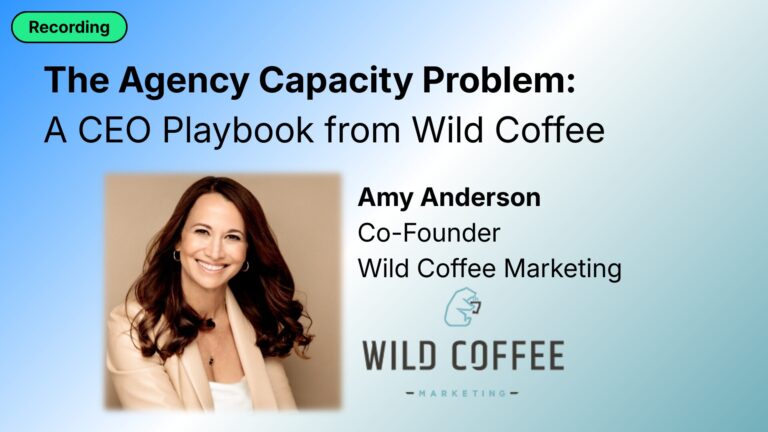
Q and A with Amy Anderson of Wild Coffee Marketing on operational clarity, capacity and utilization nuance, protecting thinking time, and practical AI use.

If you have a modern tech stack but spreadsheets are still driving planning decisions, you are not alone. They show up because they create speed and flexibility, and are good at answering questions that live between systems, but often at the cost of false confidence.