A planning gap is the space between the decisions an agency must make and what its current systems can actually show. Most agencies have one.
Few notice until margin starts moving in ways nobody can quite explain. These five questions are how to find out, before the next quarter forces the issue.
You probably already know the answer
Thursday afternoon. Pipeline meeting. Things look fine on the surface. Deals are progressing. Last month’s margin came in close to plan. Then someone mentions, almost in passing, that your senior dev is already booked through August, and your biggest active proposal needs that person in six weeks.
Nobody panics. Someone says “we’ll figure it out.” The meeting moves on.
Then you drive home and realize you priced that proposal three weeks ago. You assumed capacity. You didn’t actually know. And “figuring it out” usually means margin gets quietly absorbed somewhere in delivery, where leadership notices it three months later if at all.
That moment, the gap between what you decided and what you actually had to decide with, is the planning gap. Five questions help you tell whether your agency has one and how expensive it’s becoming.
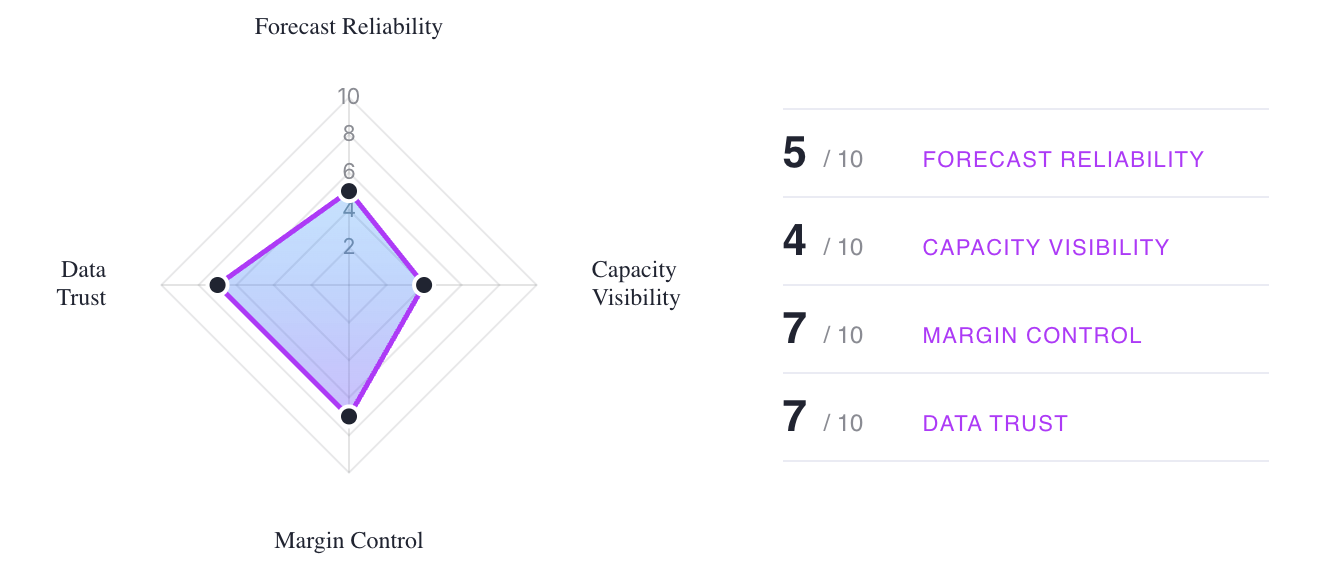
The Planning Gap Grader
Take our 60 second gap grader and get your personal score, so you can start closing your gaps.
Question 1: When you priced your last big project, did you know who would actually be available to deliver it?
Pricing on a capacity gut check is the most common entry point for a planning gap. The cost shows up in margin two quarters later, not at sale time.
A planning gap usually announces itself first at the pricing stage. If sales priced based on a generic team rate or a yes-we-have-bandwidth gut check from ops, the gap has already cost you margin. You just won’t see the bill for two quarters.
Most agencies have a CRM that shows what’s likely to close and a PM tool that shows who’s working on what today. Almost none have a single view that connects the two. Sales runs the timeline. Ops checks the calendar. Whoever has the most leverage in that conversation wins, and the answer that emerges has very little to do with what your team can actually deliver in the proposed window.
This is fixable in spreadsheets, briefly, until the company grows past about 25 people. After that, the manual reconciliation between pipeline and people takes longer than the deal cycle, so the assumption hardens before the data catches up. Pricing decisions get made on yesterday’s headcount picture. Margin leaks the difference.
If you can answer this question with a name, a date, and a confidence level rather than a feeling, you’re operating without a planning gap on this dimension. Most agencies operating with disconnected pipeline and capacity data cannot.
Question 2: How far ahead can you see capacity before you have to commit?
Planning happens at the pace of visibility. Most agency decisions span 8 to 16 weeks, but most forecasts show only 4 weeks ahead.
Planning happens at the pace of your visibility. If you can see four weeks ahead, you can plan four weeks ahead. Anything past that is a guess dressed up as a forecast.
Here’s the hard part. Most major agency decisions span eight to sixteen weeks. Hiring takes 60 to 90 days. Onboarding takes another 30. A new client’s first project usually scopes 12+ weeks out. Quarterly utilization plans require visibility through end-of-quarter at minimum.
So if your visibility is four weeks and your decisions span twelve, you’re not actually planning. You’re reacting on a slight delay.
Note that this isn’t a question of whether your tools could show capacity twelve weeks out. Most could, in theory. It’s whether they show it in a way leaders trust enough to make a real decision off of. A spreadsheet with hard-coded availability does not count. A PM tool with no demand signal does not count. The forecast has to combine pipeline weight, current allocations, planned PTO, anticipated ramp, and confirmed delivery, in one place, refreshed often enough that the numbers have not gone stale. (That’s the gap spreadsheets quietly fail to fill.)
A useful test: when did your capacity forecast last update? If the answer is “a month ago, when I rebuilt it,” you have a planning gap.
Question 3: When utilization drops, do you know whether to hire, redeploy, or wait?
Utilization moves. The planning gap is whether you can tell, in the moment, if it’s structural or temporary, before the decision window narrows.
Utilization moving is information. What to do about it requires interpretation. The planning gap is the difference between the two.
Most agencies see utilization shifts after the fact. By the time the number lands in a finance report, the team has already absorbed the impact, and the decision window has narrowed. The reactive moves, scrambling for billable work, deferring hiring, redeploying a senior to fill in, all cost more than the planned moves would have. (A weekly resourcing meeting can close this loop, if it’s run as a planning meeting and not a status meeting.)
What you actually need to answer is whether the drop is structural, like a long client wound down or the pipeline weight shifted, or temporary, like two PMs are between projects and three start dates moved. Those situations want opposite responses. Without enough planning context to tell the difference, agencies tend to overcorrect on whichever signal is loudest. They hire too late, then over-hire when revenue catches up. They redeploy a strong senior into a junior role to fill a week, and they don’t replace that senior when their slot opens up two weeks later.
If your last three responses to utilization shifts looked the same regardless of cause, the gap is showing up in your headcount plan and probably in your hiring budget.
Question 4: When a project slips, can you see margin impact in the same view as the schedule impact?
Projects slip. The planning gap is whether the schedule impact and the margin impact arrive at leadership in the same conversation, in real time.
Projects slip. That part is normal. The planning gap is whether you can see what the slip costs at the moment it happens, or only later, when finance closes the books.
PM tools show the slip clearly. New end date. Updated milestone. Owner notified. Finance, in a separate tool, with separate timing, shows the cost: extra hours billed, fixed-fee margin compression, downstream impact on the project that was supposed to start when this one finished.
Those two views rarely connect. PMs flag the slip. Finance closes the month. Nobody in between converts “two weeks late” into “$32,000 of margin spread across this project and the next two.” Leaders learn about the cost at the next month-end, by which point three more projects are slipping and nobody can disentangle which slip caused which margin miss. (An agency wrote off $100K against one project they couldn’t see in time.)
Connecting the two views is what closes this part of the gap. It does not require a financial dashboard for every PM. It requires that the schedule and the margin live in one planning layer, so the slip and the cost arrive at leadership in the same conversation.
If you can name your top three slipped projects this quarter and tell us their margin impact in one sentence each, this part of your gap is small. Most agency leaders cannot.
Question 5: If your top three projects each shifted timeline by a week, would your forecast update automatically?
Static forecasts freeze at creation. Volatility doesn’t. The planning gap is whether your forecast keeps up with the world, or has to be rebuilt to.
Static forecasts freeze at the moment they’re created. The world does not. Volatility shows up in projects daily. The planning gap is whether your forecast can keep up.
Open your forecast right now. If it lives in a spreadsheet that someone manually rebuilds every Monday, the answer is no, it would not update. Someone would have to remember the slips, find them, transcribe them in, recalculate the dependencies, and reissue the file. Most weeks, that does not happen on Monday. It happens the week the CFO asks. By then the forecast has drifted from reality by enough to be misleading.
A connected planning layer updates the forecast as the underlying data moves. The schedule changes, capacity shifts, pipeline weight rebalances, and margin reflects all of it. Leaders can ask questions of the forecast without needing it rebuilt first.
This is the test that catches the most agencies. Answers to questions one through four might be partial. Question five is binary. Either the forecast keeps up, or it doesn’t.
What the answers tell you
Be honest about the count.
One uncomfortable answer usually means a single team or process has a planning tension. Worth fixing. Probably manageable inside a quarter without new infrastructure.
Two or three uncomfortable answers means the gap is structural. Margin is leaking in places nobody can yet quantify, but it’s leaking. The fix is rarely another PM tool or another finance system. The fix is a planning layer that connects what the existing systems already collect.
Four or five means the gap is shaping decisions that drive the business. Pricing, hiring, capacity, margin. Every quarter without addressing it costs more than the previous one, because volatility compounds against weak forecasts faster than it does against strong ones.
Based on Parallax’s work with over 130 clients. Sample period: 2024 to 2025. Source: aggregate Parallax planning data. Most agencies in that group land at three uncomfortable answers when they first run through these questions. The work to get from three to one isn’t reorganizing the team or replacing tools. It’s giving leaders a planning view that matches the decisions they’re being asked to make.
A planning gap is not a tooling problem
These questions can feel uncomfortable because most agency leaders have already invested in good tools. PM tools work. Finance systems work. CRM works. The gap isn’t that the tools are broken. It’s that they were each built for a different job, and nobody built the layer that connects them for forecasting purposes.
Agencies feel the gap rather than see it because no one tool is failing. Each is doing exactly what it was built for. What’s missing is the forecast, and forecasts don’t show up as a missing tool. They show up as decisions that don’t quite line up with the data, again and again, until someone names it.
Parallax was built to be that planning layer. Naming the gap is the first move. Closing it is the next.
What to do with this
If three or more of these questions made you flinch, the most useful next step is to see what the planning layer looks like in practice, applied to your own agency’s decisions. A walkthrough takes about thirty minutes and produces a written read on where your gap sits and what closing it would change.
Frequently Asked Questions
What is a planning gap?
A planning gap is the gap between the decisions an agency is being asked to make and the data its current systems can actually show. PM tools show today. Finance shows last month. Neither shows next quarter in a way leaders can act on. The space between is the gap.
How is a planning gap different from poor planning?
Poor planning is a process failure. A planning gap is a tooling and visibility failure. Most agencies with planning gaps have strong leaders and good processes. The gap is structural, not cultural. The fix is connection, not motivation.
Can spreadsheets close a planning gap?
Sometimes, briefly. Spreadsheets work for agencies under 25 people who have one person tracking everything. Past that size, the manual reconciliation between pipeline, capacity, and margin takes longer than the decision cycle, so the spreadsheet is always behind reality by the time anyone consults it.
How big does an agency need to be before a planning gap matters?
Around 25 to 30 people. Below that, leaders can hold the planning picture in their heads and the gap rarely costs more than the time it takes to fix in spreadsheets. Above that, the gap shows up in margin variance, hiring lag, and forecast accuracy that drifts from reality each quarter.
What signals show a planning gap is costing money?
Forecast variance over 5%. Hiring decisions made reactively after utilization spikes. Pricing decisions made without confirmed capacity. Project margin discussions that happen at month-end rather than at the moment a slip occurs. Any one of these is normal occasionally. All four together are the gap.
Is the planning gap the same as resource management?
No. Resource management is operational, week to week. The planning gap is upstream of that, at the level of pricing, hiring, and capacity strategy. Good resource management can run inside a planning gap, but it cannot close the gap on its own.
Can a fractional CFO close a planning gap?
A fractional CFO usually closes the financial reporting side of the gap by improving the rear-view picture. Agencies with planning gaps still need the forward-view layer, which is operational rather than financial, and which connects pipeline, capacity, and delivery in one place. The two efforts are complementary, not interchangeable.